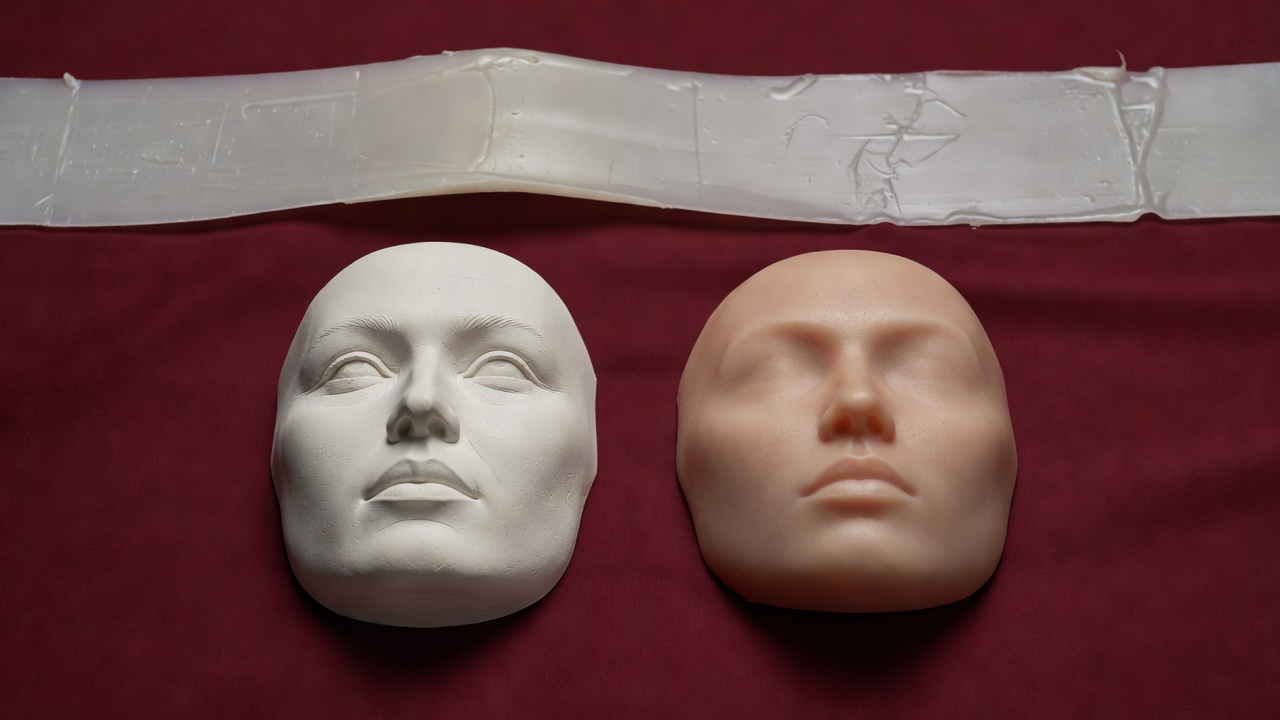
- Definition
- A prosthetic appliance is a pre-made piece, usually cast from a sculpture, that is glued to the skin and blended with makeup to change a performer's features beyond what paint alone can achieve.
- Related
- Life cast, alginate, foam latex, silicone, Pros-Aide, bald cap
- Reading time
- ≈ 5 min
3.1 From putty to appliances
Before moulded appliances, character changes relied on nose putty, mortician's wax, cotton, collodion and crepe hair built directly on the face. Lon Chaney, known as "The Man of a Thousand Faces," designed his own transformations, most famously for The Phantom of the Opera (1925), using wire, putty and paint. Jack Pierce created Boris Karloff's look for Universal's Frankenstein (1931) by layering cotton, collodion and greasepaint each day.
Foam latex changed the craft. Lightweight and flexible, it allowed full faces to move with the performer. It was used on The Wizard of Oz (1939), and later artists refined it into the standard material of the mid-century. Dick Smith, whose 1965 Monster Make-Up Handbook introduced many readers to the field, pioneered overlapping multi-piece appliances for films including Little Big Man (1970) and The Exorcist (1973), and won an Academy Award for Amadeus.
3.2 The standard workflow
- Life cast. The performer's face or body is covered in skin-safe alginate or silicone, backed with plaster bandage, to capture an exact negative.
- Positive. The negative is filled with stone or plaster to produce a durable replica.
- Sculpture. The new features are sculpted in oil-based clay directly on the replica, with edges thinned to almost nothing.
- Moulding. A mould is taken of the sculpture; the clay is removed, leaving a cavity in the shape of the appliance.
- Running the piece. Foam latex, silicone or gelatin is poured or injected into the mould and cured.
- Application. The piece is glued, edges are blended, and the whole is painted to match skin.
3.3 Materials compared
| Material | Strengths | Limitations |
|---|---|---|
| Foam latex | Very light, flexible, good for large pieces | Opaque, needs sealing; latex allergy risk |
| Platinum-cure silicone | Translucent, skin-like movement | Heavier; requires encapsulation or deadener |
| Gelatin | Translucent, inexpensive | Softens with heat and sweat |
| Transfers | Very thin edges, quick application | Limited to low-relief pieces |
Silicone appliances are often encapsulated: the silicone is enclosed in a thin plastic skin so it can be glued and painted. Transfers are typically made from an acrylic adhesive such as Pros-Aide thickened with a filler, cast flat and pressed onto the skin like a decal.
3.4 Adhesives and removal
Spirit gum, a resin dissolved in solvent, remains common for hair pieces and lace. Medical-grade silicone adhesives and acrylic adhesives hold heavier appliances through long shooting days. Removal is as important as application: each adhesive has a matched remover, and pulling pieces off dry skin can cause irritation. Professionals allow time at the end of the day for gentle removal and skin care.
3.5 Digital and practical together
Computer-generated imagery has not replaced prosthetics. Many productions use practical appliances as a base and refine them digitally, because performers react to physical makeup and camera crews light real surfaces more easily. Rick Baker, who won the first competitive Oscar for makeup, and later artists have worked across both methods.
Citations
- Smith, D. Dick Smith's Do-It-Yourself Monster Make-Up Handbook. 1965.
- Debreceni, T. Special Makeup Effects for Stage and Screen. Focal Press.
- Corson, R., Glavan, J., Norcross, B. G. Stage Makeup. Routledge.
- Academy Awards database. oscars.org