- Definition
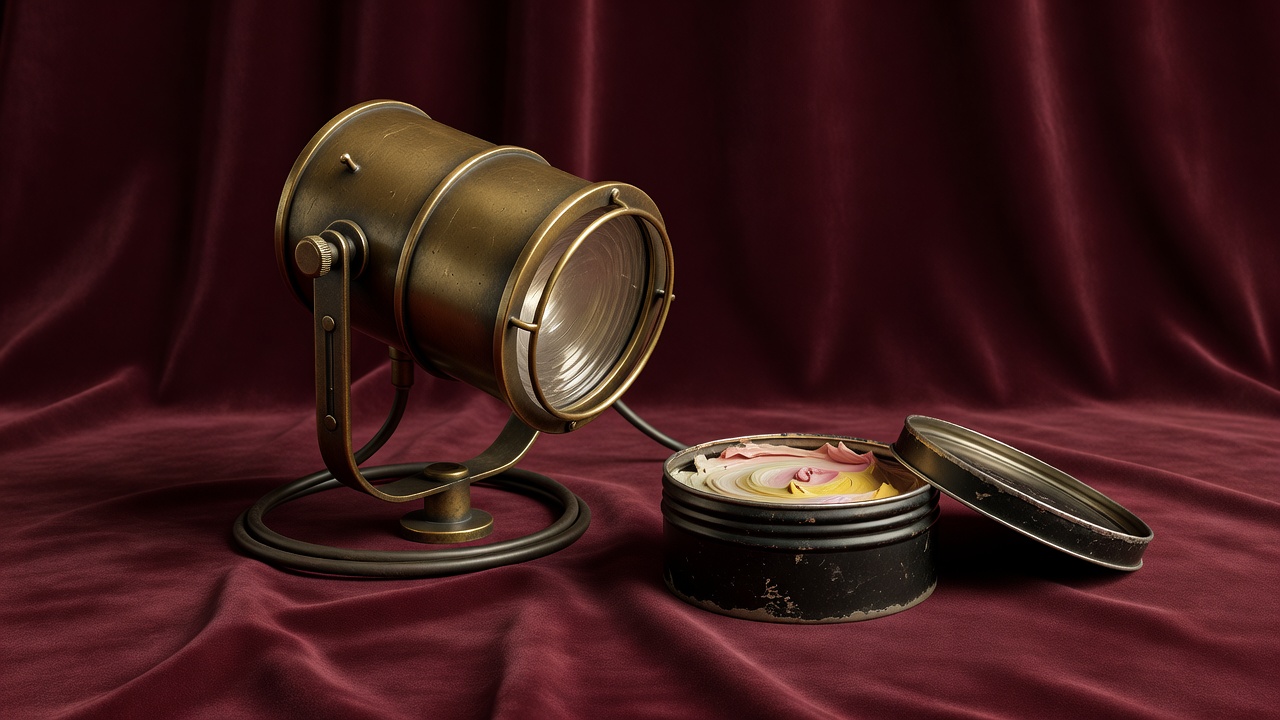
- Stage makeup is colour applied to a performer's face and body so that features, age and character remain legible to an audience seated at distance under artificial light.
- Related
- Greasepaint, colour temperature, gel, highlight, contour
- Reading time
- ≈ 5 min
1.1 Why light dictates makeup
Strong frontal light flattens a face. The shadows that normally describe cheekbones, eye sockets and the jaw are washed out, and from the middle of an auditorium a performer can appear featureless. Stage makeup exists largely to restore those shadows and highlights artificially. The standard method — darker tones where the face recedes, lighter tones where it projects — is described in every major manual, including Richard Corson's Stage Makeup, first published in 1942 and still revised today.
Distance is the second variable. A detail that reads clearly at three metres disappears at thirty. Theatrical practice therefore scales the strength of makeup to the size of the house: a studio theatre with eighty seats calls for near-natural work, while an opera house of two thousand seats tolerates, and often needs, bold lines around the eyes and mouth.
1.2 A short history of the lit stage
Candles and oil lamps gave a dim, warm light from below, delivered largely by footlights. Limelight, produced by heating a block of quicklime, brought an intense focused beam to theatres from the mid-nineteenth century. Gas lighting allowed dimming from a central control. In 1881 the Savoy Theatre in London became the first public building lit entirely by electricity, and electric light quickly became standard.
Each change altered makeup. Brighter, whiter light exposed the powdery chalks and burnt cork of earlier practice. In the 1870s Ludwig Leichner, an opera singer in Berlin, began manufacturing greasepaint in sticks, offering consistent, blendable colour that survived heat and perspiration. Greasepaint remained the professional standard well into the twentieth century and is still made by companies such as Kryolan (founded in Berlin in 1945) and Mehron (founded in New York in 1927).
1.3 Colour temperature and gels
Light sources are described by colour temperature in kelvin. Tungsten theatre lamps sit near 3200 K and render a warm, amber-leaning white; daylight-balanced sources sit near 5600 K. Designers then colour the beam with gels — thin filters supplied by manufacturers such as Rosco and Lee Filters. Makeup artists must anticipate those choices, because coloured light shifts pigment dramatically.
| Light tint | Effect on reds | Effect on shadows |
|---|---|---|
| Amber / straw | Warmed, can turn orange | Browns soften |
| Pink / rose | Flattering, may vanish into skin | Lightened |
| Lavender | Cooled, deepened | Greyed |
| Green | Darkened toward brown | Muddied, sallow |
The practical rule is to test makeup under the actual rig during technical rehearsal rather than under dressing-room bulbs. Many companies schedule a dedicated makeup check from the auditorium for exactly this reason.
1.4 LED fixtures
Contemporary rigs increasingly use LED fixtures that mix colour electronically. Early units with limited emitter colours could render skin unevenly, making some foundations appear grey or greenish. Newer fixtures with additional emitters, such as lime or amber channels, improve skin rendering. For makeup this means fewer assumptions: the same show may move between warm and cool states in a single scene, so neutral foundations and well-blended contour tend to survive best.
1.5 Practical sequence
- Read the lighting designer's intentions and gel list where available.
- Choose a base slightly deeper than the performer's skin to counter wash-out.
- Contour and highlight according to house size.
- Define eyes and brows so they read from the back row.
- Set with powder to control shine and perspiration.
- Check from the auditorium under show lighting and adjust.
Citations
- Corson, R., Glavan, J., Norcross, B. G. Stage Makeup. 11th ed. Routledge.
- Kehoe, V. J-R. The Technique of the Professional Make-Up Artist. Focal Press.
- Pilbrow, R. Stage Lighting Design: The Art, the Craft, the Life. Nick Hern Books.
- Savoy Theatre history, electric lighting of 1881. savoytheatre.org